There are many processing software for planetary imaging, and many are excellents. But to finalise the processing, and whatever software I have used, I always go back to Registax 6 ! Here is why… Registax 6 is one of the best planetary processing softwares. I have always difficulties to perceive real differences between softwares when aligning or selecting frames but there is one step where Registax 6 looks unbeatable to me: the good enhancement of details. To me it is strong on two points: noise reduction, and resizing.
Hi there, I have a problem using Registax 6 when it keeps having a blank screen when I start to stack. It keeps saying: has anyone got any solutions? This the first time a tried aligning and stacking an image and it happened) Any help would be great, Regards. Sep 27, 2019 When your image first loads into RegiStax it can look quite bland and blurry. If your image is a little dark when loaded, look to the Functions tab on the right-hand side of the program and click Histogram. Adjust the middle slider to the left to brighten the image. This will help you to see what is happening as you make adjustments.
 With Registax 6, the gaussian blur is completely integrated to the processing software and you drive it like the wavelets, with sliders. A very comfortable innovation :)Here is the first step of my usual processing routine. I’m using the Dyadic wavelets. Make sure as well that the gaussian filters are on.The relevant layers to be used will vary following the sampling
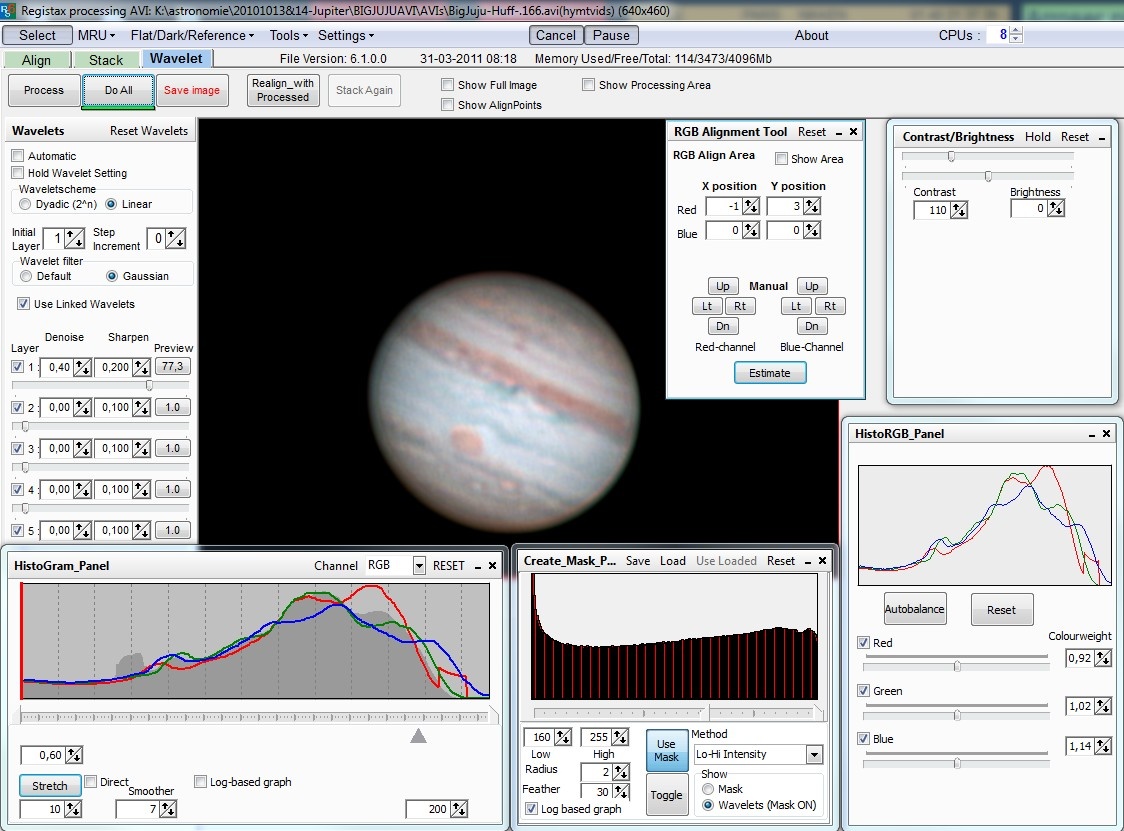 , the target and the conditions, but I first use the 2nd layer, then the 1st, partially the 3rd but never the 4/5/6.Push the sliders to the right to the point where the enhancement of details is nice to you. Here the 1 and 2 are set up to 100 % at first, but by using the Sharpen filter you can set them to more than 100 (here, 140 and 110 respectively).The result is well contrasted, but the image is too noisy !At this step you can use the gaussian filters with the Denoise filters at left.You can make them vary up and down with the arrows. The increment is then by step of 0,05, which is not very precise. You can refine directly the value inside the box, with a variation of one tenth (0,06 to 0,07…) but you can even go to one hundredth, like here at layer two (0,125).Take care of the smallest details: noise reduction must not erase them! Most of the time the value I used is under 0,1 (my processing was a bit hard here ;) )
Indeed, the main processing window already allows you to reduce noise. But the software offers as well different resizing filters to be chosen following your needs !
Registax 6.1

 Mars is a very small planet and benefits well from an enlargement…On the right menu, click on “Resize image” and this will open the dialog box. You can enlarge the image up to 200 % (you can also reduce it).Other options can be used – Flip X and Y can set right an inverted image. You can also adjust to the pixel the final size of the whole frame.But the most interesting tools are the different resizing filters at bottom left.Here are the effect of filters (click on the illustration to see its full content). They will offer a different level of smoothing so you can choose the more adequate. Lanczos looks to enlarge without effect on noise: this one is to be used for the very best images (or those one to be derotated under WinJupos). Then Mitchell and Bell show increasing levels of smoothing. Finally,